
Fishing in Ireland — The Complete Guide
From wild Atlantic shores to peaceful midland lakes, Ireland offers some of the finest fishing in Europe. Whether you cast a fly for salmon on the River Moy, troll for pike on Lough Corrib, or drop a line off a Dingle pier, this guide covers everything you need to plan your Irish fishing adventure.
Introduction to Fishing in Ireland
Ireland is rightly celebrated as one of Europe's premier fishing destinations. With over 70,000 kilometres of rivers, 140,000 hectares of lakes, and 3,100 kilometres of rugged Atlantic coastline, the island provides an extraordinary range of angling opportunities for beginners and experienced anglers alike.
The temperate maritime climate, fed by the Gulf Stream, keeps waters productive year-round. Rainfall is plentiful, rivers run high, and aquatic insect hatches are prolific — creating ideal conditions for healthy fish populations. Ireland's relatively low population density means many fisheries remain uncrowded, offering the kind of peaceful, undisturbed fishing that is increasingly hard to find elsewhere in Europe.
Irish fishing falls into three broad disciplines: sea fishing along the coast and offshore, coarse fishing in the rivers and lakes of the midlands, and game fishing for salmon, trout, and sea trout in some of the continent's most storied waters. With over 137 recorded species in Irish waters, there is always something new to target.
Licences are straightforward. No licence is required for coarse or sea fishing. Only salmon and sea trout anglers need a State licence, available as annual, 21-day, or single-day permits. This accessibility makes Ireland one of the easiest countries in Europe in which to start fishing.
Quick Facts
- 70,000+ km of rivers
- 140,000+ hectares of lakes
- 3,100 km of coastline
- 137+ fish species recorded
- Year-round fishing available
- No licence needed for most species
Types of Fishing in Ireland
Sea Fishing
Ireland's Atlantic coast is a sea angler's paradise. With over 100 saltwater species recorded by the Irish Specimen Fish Committee, opportunities range from easy shore fishing off piers and beaches to thrilling deep-sea charter trips targeting blue shark and porbeagle.
For the full picture — species, seasons, county-by-county shore marks and how to start — see our dedicated Sea Fishing in Ireland guide.
Shore fishing is the most accessible form of sea angling. Beaches, rock marks, and harbour walls all produce bass, pollack, wrasse, mackerel, and a variety of flatfish. The west and south coasts are particularly productive, with Kerry, Clare, and Galway offering world-class shore marks. Inshore boat fishing in sheltered bays targets cod, pollack, ling, and ray, while offshore charter trips from ports like Dingle, Kinsale, and Killybegs pursue blue shark, tope, and large conger eel over deep water wrecks.
Coarse Fishing
Ireland's midland lakes and slow-flowing rivers are among the best coarse fisheries in Europe. Over 20 coarse species are present, with roach, bream, rudd, tench, perch, and hybrids available in huge numbers. The Shannon system, the Erne system, and the Royal and Grand Canals are the heartland of Irish coarse fishing.
No licence is required for coarse fishing, and many fisheries are free to fish. Match anglers from across Europe travel to Ireland for competitions, drawn by the consistently high weights and beautiful, uncrowded venues. Pike fishing is also excellent, with Lough Corrib, Lough Derg, and Lough Erne producing specimen fish every season.
Game Fishing
Game fishing for Atlantic salmon, brown trout, and sea trout is the jewel in Ireland's angling crown. Rivers like the Moy, Boyne, Drowes, and Suir are internationally renowned, while loughs such as Corrib, Mask, and the Killarney Lakes offer world-class wild brown trout fishing during the famous mayfly hatch.
A State licence is required for salmon and sea trout. Anglers must carry a logbook and use gill tags when retaining salmon. Brown trout fishing requires no licence, though local permits may apply on some managed fisheries. The salmon season typically runs from January to September, while trout fishing opens in mid-February and closes in October.
Best Fishing Locations in Ireland
Lough Corrib, Co. Galway/Mayo
Ireland's largest lake and one of Europe's finest wild brown trout fisheries. The mayfly hatch from April to July draws anglers from around the world. Also excellent for pike and salmon.
Game PredatorRiver Moy, Co. Mayo/Sligo
Ireland's most prolific salmon river, producing over 6,000 salmon annually. The famous Ridge Pool at Ballina is one of the most productive salmon beats in Europe.
GameLough Erne, Co. Fermanagh
The coarse fishing capital of Ireland. Upper and Lower Lough Erne offer exceptional bream, roach, and pike fishing in a stunning lakeland setting.
Coarse PredatorRiver Boyne, Co. Meath
A classic limestone river offering superb dry fly fishing. Salmon average 7–10 lbs. The Boyne is one of Ireland's most scenic and historic rivers.
GameKillarney Lakes, Co. Kerry
Three interconnected lakes in a stunning national park setting. Excellent for salmon, brown trout, and sea trout, with the added charm of fishing beneath Macgillycuddy's Reeks.
GameLough Mask, Co. Mayo
One of Ireland's great trout loughs, known for drift fishing and wild brown trout. Connected to Lough Corrib and equally productive during the mayfly season.
GameRiver Drowes, Co. Donegal
Traditionally yields the first salmon of the Irish season. A short but productive spate river, also home to the rare Gillaroo trout.
GameLough Derg, Co. Clare/Tipperary
The largest lake on the Shannon, famous for pike and brown trout. Its sheltered bays and islands create varied fishing conditions throughout the season.
Game PredatorRiver Suir, Co. Waterford
A fine limestone river producing excellent brown trout and salmon. The middle and lower stretches are particularly good for dry fly fishing.
GameCork Harbour, Cobh & Kinsale
Top destinations for shore and boat sea fishing. Bass, pollack, mackerel, ray, and conger eel are all accessible from the shore or on short boat trips.
SeaCommon Species You Will Encounter
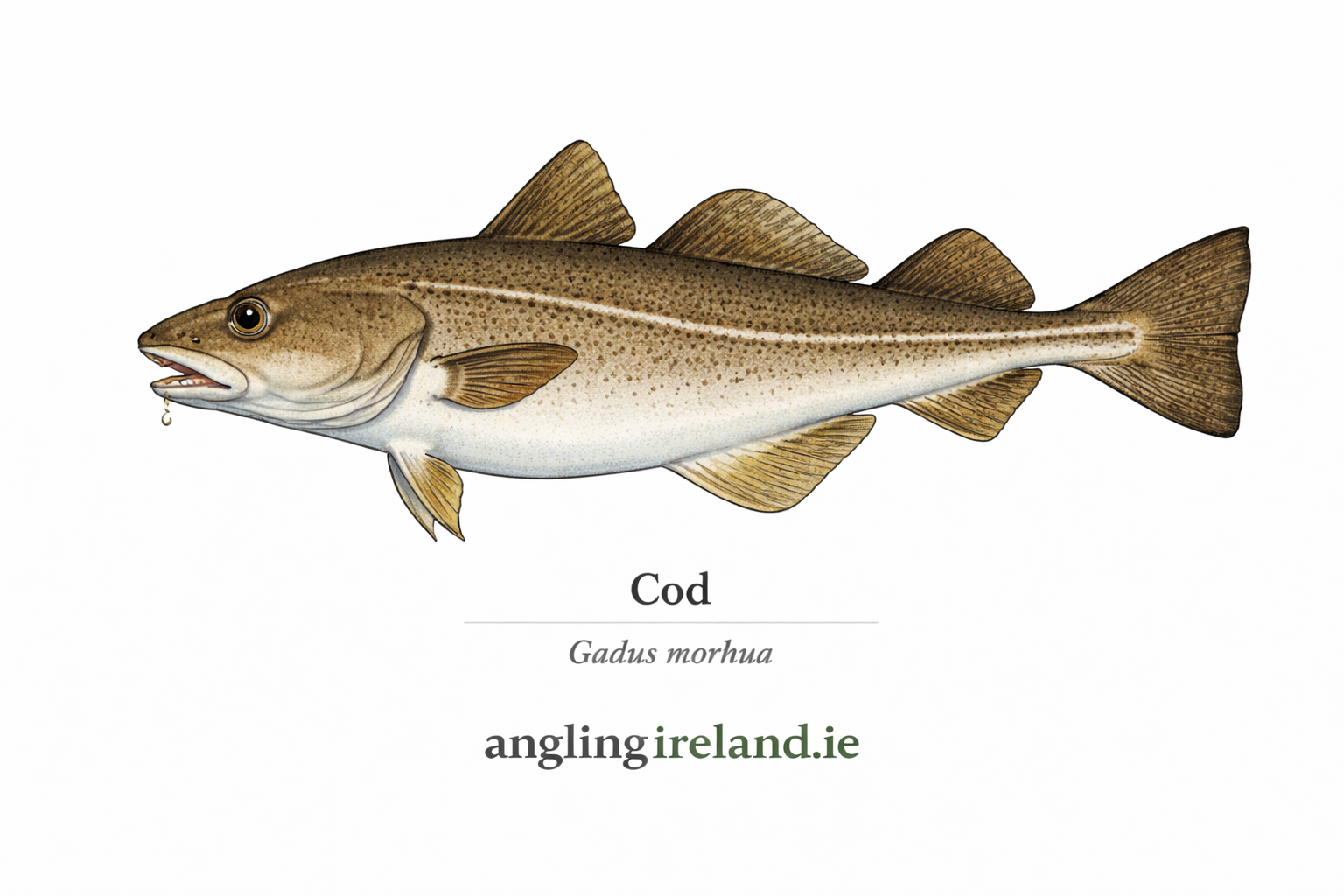
Ireland's waters are home to a remarkable diversity of fish species. Below are twelve of the most popular and commonly caught species across all three disciplines. Click any species to learn more about identification, specimen thresholds, and where to find them.




Fishing Seasons Calendar
Knowing when to fish is as important as knowing where. Ireland offers year-round angling, but specific species have defined open seasons set by Inland Fisheries Ireland. Here is a summary of the main fishing seasons.
| Species / Discipline | Open Season | Licence Required? | Notes |
|---|---|---|---|
| Atlantic Salmon | 1 January – 30 September | Yes | State licence required; gill tags mandatory; logbook must be carried |
| Brown Trout | 15 February – 12 October | No | No licence; local permits may apply on some managed fisheries |
| Sea Trout | 1 June – 30 September | Yes | Same licence as salmon; catch-and-release in many rivers |
| Pike | Year-round | No | No licence required; catch-and-release encouraged |
| Coarse Fish (roach, bream, rudd, tench, perch) | Year-round | No | No licence; many fisheries are free to fish |
| Sea Fishing (all species) | Year-round | No | No licence for most species; bass bag limit of 2 fish per day applies |
Seasons may vary by region and are subject to annual conservation orders. Always check with Inland Fisheries Ireland regulations before fishing.
Regulations Overview
Licences and Permits
Ireland's licensing system is refreshingly simple compared to many European countries. A State licence is required only for salmon and sea trout. Three licence types are available:
- Annual licence — covers the full season
- 21-day licence — ideal for visiting anglers
- 1-day licence — perfect for a single outing
No licence is needed for brown trout, pike, coarse fish, or sea fishing. Some private fisheries and managed waters require a local permit or day ticket, so it is always worth checking before you arrive.
Conservation Rules
Ireland takes fish conservation seriously. Key rules include:
- Salmon anglers must carry a logbook and use numbered gill tags
- Bass bag limit: 2 fish per day (minimum size 40 cm)
- Many rivers operate catch-and-release for salmon and sea trout
- Pike catch-and-release is strongly encouraged nationwide
- Use of live bait is prohibited on many waters
- Certain methods (e.g., spear fishing) are restricted or banned
Clubs and Community
Angling in Ireland has a strong community spirit. Hundreds of clubs operate across the country, from small local groups managing a stretch of river to large federations organising national competitions. Joining a club is one of the best ways to improve your fishing, discover new venues, and meet fellow anglers.
Clubs typically offer access to managed waters, organised competitions, coaching for juniors and beginners, and social events throughout the year. Many clubs are affiliated to national bodies such as the Irish Federation of Sea Anglers (IFSA), the National Coarse Fishing Federation of Ireland (NCFFI), or Trout Anglers Federation of Ireland (TAFI).
Ireland's competitive angling scene is thriving. Open competitions are held throughout the season in all disciplines, from local club matches to national championships. Many are free to enter or charge a modest fee, and they are a great way to test your skills against other anglers.
Find a Club Near You
Browse angling clubs across Ireland, join online, and connect with your local angling community.
Browse ClubsCompetitions
Find open competitions, view results, and enter events across Ireland.
View CompetitionsGetting Started
Choose Your Discipline
Decide whether sea, coarse, or game fishing appeals most. Each offers a completely different experience and requires different tackle.
Check Regulations
Review the current regulations for your chosen discipline. Buy a salmon licence if needed.
Join the Community
Create a free account to log catches, track species, join clubs, and enter competitions.
Ready to Start Fishing in Ireland?
Join Angling Ireland for free. Log your catches, track species, find clubs, and connect with thousands of Irish anglers.